UKCA Marking Requirements for Sellers: The 2026 Compliance Guide

Is your marketplace business actually ready for the latest regulatory checks, or are you risking a platform ban over a simple labeling error? Many sellers worry that failing to meet the latest UKCA marking requirements for sellers will lead to delisted products or lost buyer trust. It's a valid concern when the rules for the UK marketplace have shifted so much since the original transition began.
You want to grow your brand without getting buried in paperwork or high compliance costs for small batches. We've simplified the confusion. This guide gives you everything you need to know about UKCA compliance to protect your business and build buyer trust. You'll find a clear checklist for your product listings and confirmation on the legal status of your goods. We'll also explain the indefinite recognition of CE marking for most products and the specific 2027 labeling deadlines. By the end, you'll understand exactly how to handle your inventory and avoid the liability risks that often trip up independent vendors.
Key Takeaways
- Understand the 2026 status of "indefinite recognition" for CE marks and how it provides flexibility for most manufactured goods.
- Identify high-risk categories like toys and electronics that must meet specific UKCA marking requirements for sellers to remain active on the marketplace.
- Clarify your legal standing as a manufacturer, importer, or distributor to ensure you aren't unknowingly assuming full liability for product safety.
- Access a practical 5-step checklist to verify conformity assessments and keep your product documentation ready for inspection.
- Learn how to turn regulatory compliance into a trust signal that attracts professional buyers and differentiates your shop from competitors.
What is the UKCA Mark and Why Does it Matter for Sellers?
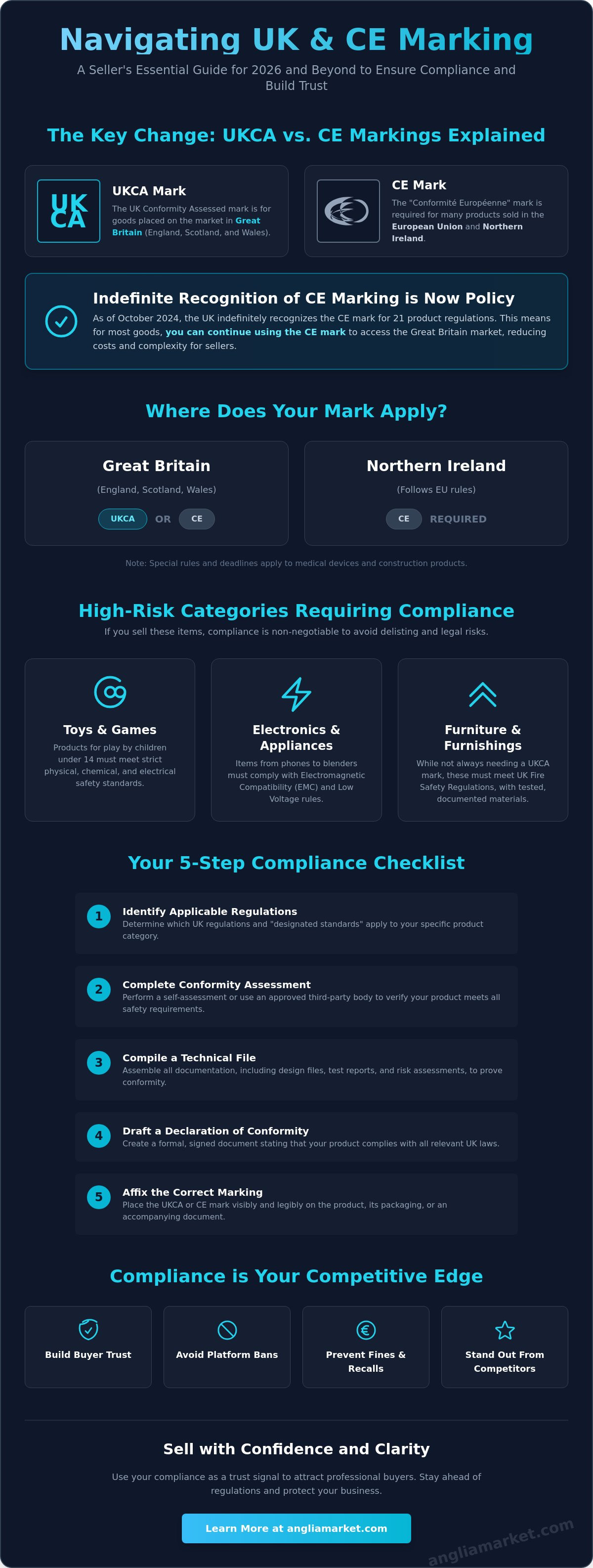
The UKCA marking, or UK Conformity Assessed marking, is the product safety label used for goods sold in Great Britain. It covers England, Scotland, and Wales. If you sell items like electronics, toys, or personal protective equipment, this mark is your declaration that the product meets UK safety standards. Understanding the UKCA marking requirements for sellers is vital for anyone moving physical goods through a professional marketplace.
The rules changed significantly on October 1, 2024, when "The Product Safety and Metrology etc. (Amendment) Regulations 2024" came into force. This legislation introduced "indefinite recognition" of the CE mark for most manufactured goods. This means that for the majority of products, you don't actually have to switch to UKCA. You can continue using the CE mark to access the Great Britain market for the foreseeable future. This policy provides massive flexibility and keeps costs down for small businesses and independent vendors on Anglia Market.
It's important to remember that Northern Ireland follows different rules. The UKCA mark isn't recognized there. Products placed on the market in Northern Ireland still require the CE marking. If you're a seller targeting the entire UK, you'll need to stay aware of these regional differences to keep your shipping and compliance strategies on track.
UKCA vs. CE: Which one should you use in 2026?
Most sellers can now choose between the CE and UKCA marks for 21 specific product regulations. This includes everything from household appliances to radio equipment. You might choose to use the UKCA mark if you want to emphasize your focus on the UK market or if you're preparing for future regulatory shifts. However, some sectors are different. Medical devices have their own deadlines. CE-marked medical devices can stay on the market until June 2028 or 2030, depending on their type. Construction products also have unique rules, though the government recently scrapped the 2025 mandatory UKCA deadline for that sector too.
The legal risks of non-compliance for marketplace vendors
Failing to meet UKCA marking requirements for sellers carries heavy risks. Trading Standards can issue fines or demand a total product recall. For an online shop, the most immediate danger is account suspension. Marketplaces will often delist products immediately if they suspect a safety marking is missing or fraudulent. You're also legally liable for any faults. If a product causes harm and lacks the correct conformity assessment, the financial and legal fallout falls directly on the seller or importer.
Does Your Product Require UKCA Marking? High-Risk Categories
Identifying which items need a safety label is the first step in managing UKCA marking requirements for sellers. Most goods that previously needed a CE mark under EU rules now fall under the UKCA regime for the Great Britain market. These are often called "New Approach" goods. While the 2024 legislative update allows indefinite CE recognition for 21 product regulations, you must still ensure your goods meet the technical safety standards. You can find specific rules for your category in the official UK government guidance.
Not everything needs a mark. General consumer goods like books, umbrellas, or standard clothing usually don't require UKCA or CE markings. However, if your product has a battery, a motor, or is intended for children, it almost certainly does. Checking your product niche early prevents the frustration of having a shipment seized or a listing removed just as you're gaining momentum.
Common marketplace categories requiring compliance
High-risk items are the most scrutinized on any platform. If you're planning to sell online, focus on these three areas where compliance is non-negotiable:
- Toys and games: Any product intended for use in play by children under 14 years old must meet strict safety requirements. This includes physical, chemical, and electrical safety testing.
- Electronics and appliances: Items ranging from smartphones to kitchen blenders must comply with Electromagnetic Compatibility (EMC) and Low Voltage regulations.
- Furniture and home goods: While not always requiring a UKCA mark, these items must meet the Furniture and Furnishings (Fire Safety) Regulations. Materials must be documented and tested for flame resistance.
How to find the "Designated Standards" for your items
A "designated standard" is a set of technical specifications the UK government recognizes as a way to prove a product is safe. To find yours, start by searching the GOV.UK database for your specific product type. Match your item to the relevant regulation, such as the "Toy (Safety) Regulations 2011." This helps you identify the exact tests your product must pass.
Don't guess. Talk to your manufacturer and ask for the Declaration of Conformity. This document lists the standards the product was tested against. If you're an independent seller, verifying this data is the best way to handle UKCA marking requirements for sellers and keep your shop's reputation intact. It's a simple step that separates professional vendors from risky ones.
Your Role: Are You a Manufacturer, Importer, or Distributor?
Your legal responsibility depends entirely on where you sit in the supply chain. Many small business owners fall into the "reseller trap." They believe they are just distributors because they didn't make the product. However, if you source goods from outside the UK and sell them in Great Britain, the law often views you as an importer. This shift in status changes everything. It moves you from simply checking a label to being legally responsible for the product's entire safety file. Understanding these UKCA marking requirements for sellers is the only way to protect your shop from unexpected legal trouble.
To identify your role, look at your primary source of stock. If you manufacture the goods or have them designed and made under your brand name, you're the manufacturer. If you're the first person to bring goods into Great Britain from a country outside the UK, you're the importer. If you buy stock from a UK-based wholesaler to sell on Anglia Market, you're a distributor. Each role has a specific set of rules to follow under the official UK government guidance on UKCA marking.
Responsibilities of an Importer
Importers carry the heaviest burden after the manufacturer. You must verify that the manufacturer has already performed the correct conformity assessment. You also need to ensure that the technical documentation is available to authorities for 10 years after the product is placed on the market. Crucially, you must place your own company name and contact address on the product or its packaging. This makes you the point of contact for Trading Standards if a safety issue arises with your electronics or other regulated goods.
Responsibilities of a Distributor
Distributors have a "due care" obligation. You don't need to hold the technical file, but you must check that the product has the correct UKCA or CE mark. You are also responsible for ensuring that all instructions and safety information are written in clear English. While the goods are in your possession, you must ensure that storage or transport conditions don't jeopardize their compliance. Even if you just sell online, failing to spot a missing safety mark can lead to your listings being flagged and removed. Taking these UKCA marking requirements for sellers seriously ensures your business stays professional and reliable.
The 5-Step Compliance Checklist for UK Marketplace Sellers
Securing your shop starts with a clear process. Meeting UKCA marking requirements for sellers doesn't have to be a hurdle if you follow a logical path. Whether you're moving electronics or toys, these five steps keep you legal and ready for the UK market.
- Step 1: Verify the product category. Check if your item falls under the 21 regulations that require a conformity mark. This includes items like radio equipment, pressure vessels, and measuring instruments.
- Step 2: Confirm the Assessment. Ensure the manufacturer has completed a formal Conformity Assessment. This might be a self-declaration for low-risk items or a third-party check by a "UK Approved Body" for high-risk goods.
- Step 3: Get the Declaration of Conformity (DoC). You must have a copy of the UK Declaration of Conformity. This is the paper trail that proves the product was tested against the correct UK standards.
- Step 4: Label the product. Check that the UKCA or CE mark is visible. Remember, the 2024 regulations allow you to use either mark for most goods indefinitely.
- Step 5: Store your records. Keep all technical files and the DoC for 10 years after the last unit is sold. Trading Standards can request these documents at any time.
Drafting or checking the Declaration of Conformity
A valid DoC must include the manufacturer's name, the product's serial number, and a list of the specific UK legislation the product follows. Look for a signature from a company representative. If the certificate is missing a date or uses vague language, it's likely incomplete. The Declaration of Conformity is a formal legal claim that the product meets all applicable safety requirements. Don't accept a generic "safety certificate" as a substitute for this specific document.
Rules for physical marking: Size and placement
The UKCA logo must be at least 5mm in height unless the specific regulation allows for a smaller size. You must maintain the proportions of the symbol; it cannot be stretched or distorted. Current rules offer significant flexibility. Until 11 pm on December 31, 2027, you can place the UKCA marking on a label affixed to the product or on an accompanying document instead of the product itself. This is great for small batches where permanent engraving is too expensive. Ready to grow your shop safely? Open your seller account on Anglia Market today.
Managing UKCA marking requirements for sellers is about attention to detail. By following this checklist, you protect your account from suspensions and ensure every customer receives a safe, compliant product.
Building Buyer Trust through Compliance on Anglia Market
Compliance is more than a legal box to tick. It's a powerful commercial asset. Professional buyers and savvy consumers look for safety markings to ensure they're buying quality goods. By meeting UKCA marking requirements for sellers, you signal that your business is reliable and professional. This transparency builds long-term loyalty and reduces the risk of returns or negative feedback. In a crowded marketplace, trust is the currency that converts a browser into a buyer.
Marketplace success depends on standing out. Mentioning your adherence to safety standards in your product descriptions turns a technical necessity into a marketing win. It shows you care about customer safety. This is especially true for independent vendors who need to compete with larger brands on trust. When a buyer sees a clear mention of conformity, they feel more secure in their purchase. It proves you're a legitimate business operating within the UK's legal framework.
Compliance as a USP for independent sellers
Differentiate your shop from non-compliant international sellers by highlighting your safety standards. Whether you're selling electronics or toys, showing that you understand UK regulations gives you a massive edge. You can use your vendor profile to mention your commitment to quality. This builds a reputation for excellence that keeps customers coming back to your store.
Consider adding these trust signals to your listings:
- Mention that your products meet all relevant UK safety standards.
- State that a Declaration of Conformity is available upon request.
- Highlight clear, English-language instructions for complex items.
- Use your profile to showcase your status as a verified UK-based vendor.
Getting started with Anglia Market
Joining an Online Marketplace for Sellers like Anglia Market gives you the platform to reach a massive audience. We focus on supporting UK SMEs as they scale their operations legally and safely. Our community-oriented approach means you're part of a network of regional independent businesses. We provide the platform; you provide the quality goods that UK shoppers want.
Ready to list your products? The next step is simple. Register as a vendor and start uploading your compliant inventory. By following the UKCA marking requirements for sellers we've covered, you can grow your brand with confidence. Focus on your sales while knowing your business foundations are solid. Build your shop on a platform that values independent commerce and transactional security.
Future-Proof Your UK Marketplace Strategy
Regulatory shifts don't have to slow your growth. The most important takeaway for 2026 is that indefinite CE recognition remains in place for 21 major product categories. This provides the flexibility you need to manage costs while staying legal. By mastering the UKCA marking requirements for sellers, you move beyond mere compliance. You're building a brand that professional buyers trust because it prioritizes safety and transparency. Whether you're an importer or a distributor, having your technical documentation ready for the 10-year storage rule keeps your business resilient against audits.
Ready to take your business to the next level? Join a community of regional independent vendors who value quality and security. We are trusted by thousands of UK SMEs and offer a secure transactional platform designed to help you scale. Our team provides dedicated support for independent vendors so you can focus on your inventory rather than red tape. Start selling your compliant products on Anglia Market today. Your journey toward a successful, compliant online shop starts here.
Frequently Asked Questions
Can I still sell products with a CE mark in the UK in 2026?
Yes, for the majority of manufactured goods, you can use the CE mark indefinitely. The UK government passed legislation in October 2024 to allow dual recognition across 21 product regulations. This includes popular categories like toys and electronics. Exceptions apply to medical devices and construction products, which have their own specific timelines through 2028 and 2030.
What happens if I sell a product without a required UKCA mark?
Selling non-compliant goods leads to serious penalties, including product recalls and fines from Trading Standards. On a platform like Anglia Market, failing to meet UKCA marking requirements for sellers can result in immediate listing removal or account suspension. You also face legal liability if a non-compliant product causes injury or property damage while in a customer's possession.
Does the UKCA mark apply to second-hand or used goods?
The UKCA mark usually doesn't apply to used goods that were already legally sold in the UK before the rules changed. However, if you import used products from outside the UK to sell them here for the first time, they are considered "newly placed" on the market. In this case, they must meet current safety standards and carry the correct conformity marking.
As a drop-shipper, am I responsible for the UKCA marking?
Your responsibility depends on where your supplier is located. If you drop-ship from an international supplier directly to a UK customer, you are often legally the importer. This means you must ensure the product is compliant. If your supplier is based in the UK, you act as a distributor and only need to check for the presence of the mark and correct documentation.
Where can I download the official UKCA logo for my packaging?
You can download the official UKCA logo files directly from the GOV.UK website. The files are available in various formats like .eps and .png for your designers. When using the logo, you must follow the "5mm rule" for height and ensure the proportions aren't distorted. The mark must be easily visible, legible, and permanently placed on the product or its packaging.
Do I need a separate UKCA mark for Northern Ireland?
Yes, you need a CE mark for Northern Ireland. The UKCA marking is not recognized in that region under the Northern Ireland Protocol. If you use a UK-based body for your conformity assessment, you may also need to apply the UKNI marking alongside the CE mark. Always check regional requirements if you plan to ship your goods across the entire UK market.
How much does it cost to get a product UKCA certified?
Costs vary significantly depending on the product type and whether you can self-declare compliance. For low-risk items, the cost is mainly the time spent on documentation and technical files. For high-risk goods requiring a "UK Approved Body" for testing, fees depend on the complexity of the standards. You should contact testing labs directly for quotes based on your specific product niche.
What documentation do I need to show a marketplace if they ask for proof of compliance?
The primary document you need is the UK Declaration of Conformity (DoC). This document proves you've met the UKCA marking requirements for sellers by listing the relevant safety standards and legislation. You should also keep test reports and technical files ready in your records. Marketplaces often ask for these documents during the onboarding process or after a customer complaint to verify product safety.

Article by GJEVAT KELMENDI
If you have any questions regarding this disclaimer or any of our policies, please contact Anglia Market through the contact page on our website, by email using the address provided on the site, or by phone at 0333 772 2593
No posts found
Write a review