Which UK marketplace suits your business and products?

The biggest marketplace isn’t automatically the best fit. For a UK business, the right online marketplace for sellers depends on your business size, the products you offer and the customers you want to reach. UK online marketplaces and peer-to-peer platforms generated around £34.1 billion in GMV, excluding VAT, in 2025, so choosing where to sell is a practical business decision.
It’s easy to focus on customer numbers, but product fit and how a platform works for your business matter just as much. A broad product range may suit a general marketplace, while specialist products may perform better with a focused audience.
This guide explains how to compare UK marketplaces by business size, product type and target customers. You’ll also find a practical way to identify which option best fits your selling goals.
Key Takeaways
- Match a marketplace to your business size, product range and the customers you want to reach.
- Compare each platform’s audience and selling requirements before deciding where to list your products.
- Assess the full fee structure, including how listing charges and commissions could affect your margins.
- Consider Anglia Market as a marketplace option for reaching customers with a range of physical goods.
Choosing a UK marketplace by business size, products and target customers
Start by deciding what you sell, who you want to reach and how much listing work you can manage. An independent maker selling handmade jewellery has different needs from an established brand offering homewares. Choose a platform whose audience matches your products and whose tools suit your team’s capacity.
Specialist craft marketplaces can suit handmade, vintage and craft products. General retail marketplaces may fit repeatable goods across categories, while auction formats can suit collectables or one-off items. Compare category rules and how shoppers find each listing.
| Option | Product fit | Audience and selling approach | Management consideration |
|---|---|---|---|
| Specialist craft marketplace | Handmade, vintage and craft goods | Shoppers seeking distinctive finds | Maintain accurate variations and stock |
| General retail marketplace | Repeatable products across categories | Broad product-search audience | Keep listings and inventory aligned |
| Auction marketplace | Collectables or one-off goods | Buyers comfortable with bidding | Set clear listing and dispatch details |
| Your website | Products needing a distinct brand experience | Customers reached through your channels | Manage the storefront and promotion |
Choose the option that fits your audience and daily workload. If you sell across a marketplace and your website, use a product feed or central stock system to synchronise listings, inventory and orders. Update discounted products across channels to avoid outdated prices or overselling. A guide to selling online can help you plan listings.
UK tax and VAT treatment depends on your business and transactions. Keep clear records of sales and related costs for your accounts.
Common challenges include competing listings, price pressure, stock mismatches and managing orders across platforms. For example, selling the last item through one channel without updating another can lead to an oversell.
Marketplace for UK businesses and independent sellers
UK online marketplaces and peer-to-peer platforms generated around £34.1 billion in GMV, excluding VAT, in 2025. For an independent seller, reaching those buyers is only part of the decision. Consider how product listings are presented, how payments are handled and what information helps you manage orders after each transaction.
A marketplace can help a small online business reach shoppers already browsing for products. Compare its audience and listing tools with your own website, where you control the storefront but must attract customers yourself. A seller of personalised gifts, for example, might value product options and clear descriptions, while a business with repeatable stock may prioritise bulk listing tools. Selling internationally can extend your reach, but requires planning for fulfilment and customer support across destinations.
Seller fees and commission rates
Seller charges vary by platform, so assess how each affects your expected proceeds. Check for listing, transaction and payment-processing charges, and include any optional services you plan to use. A platform with a lower commission may still cost more overall if other charges apply. Compare equivalent products and order values, and read the current fee terms before setting prices.
Seller protections and dispute processes
Each marketplace sets its own protection and dispute procedures. Read the terms covering buyer complaints, payment disputes, refunds and the evidence sellers may need to provide. Keep order messages, product details and dispatch records together so you can find relevant information easily if a transaction is challenged. Don’t assume one platform’s process applies to another.
Before registering, compare the marketplace’s buyer audience, account tools and terms with the way your business manages listings and orders. This helps you choose a channel that fits your operation, rather than relying on popularity alone.
What are the seller fees and commission rates on UK online marketplaces?
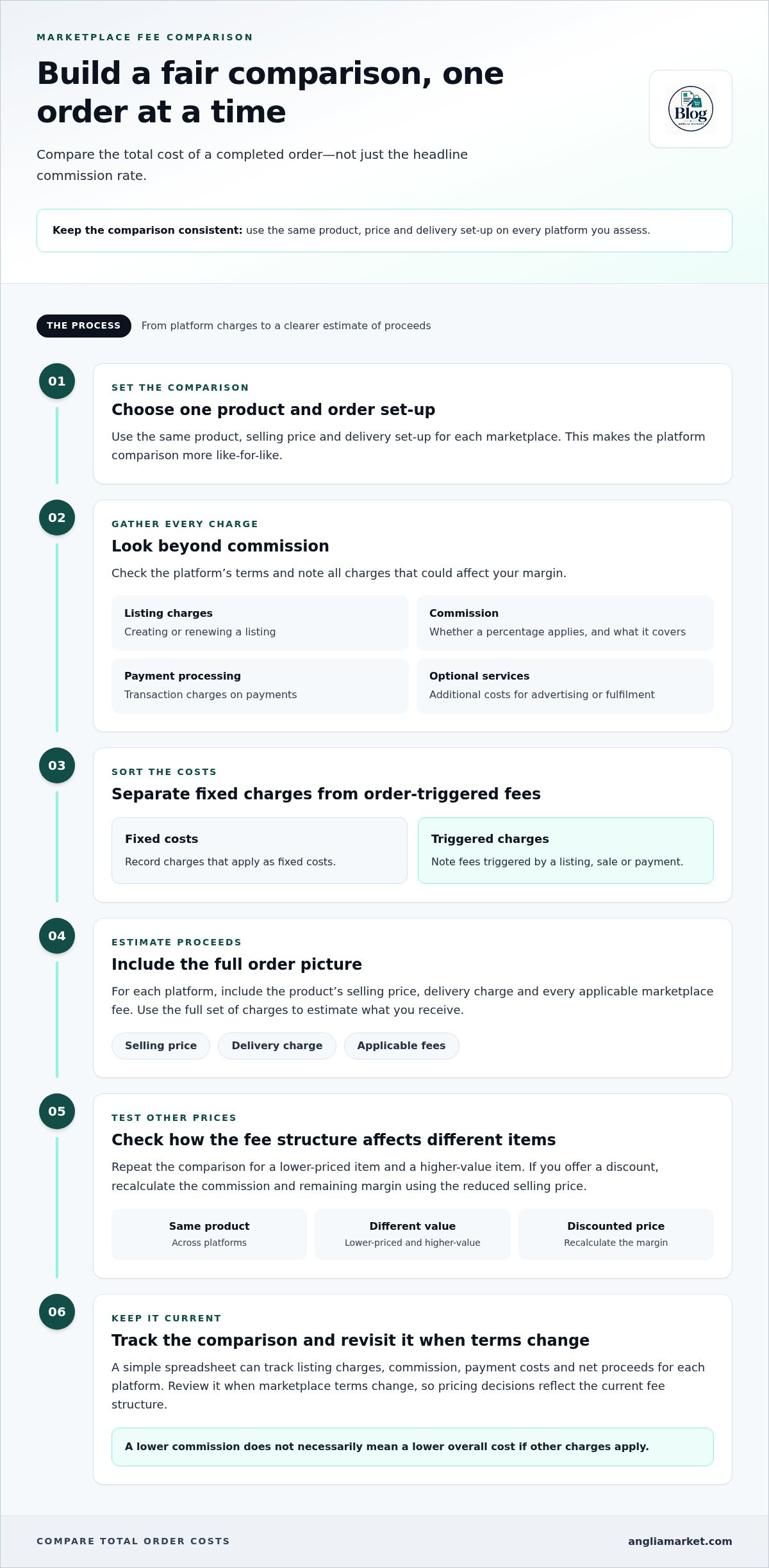
There’s no standard seller tariff across UK platforms. Each online marketplace for sellers in the UK sets its own charges, which may depend on category, listing type and selling plan. Compare the total cost of a completed order, not just the headline commission rate. For a fair comparison, use the same product, price and delivery setup on each platform.
Before choosing, record every charge that could affect your margin. Separate fixed costs from charges triggered by a listing, sale or payment. Then compare the same order across each online marketplace for sellers in the UK you’re considering.
- Listing charges: Check whether creating or renewing a product listing carries a fee.
- Commission: Find out whether the platform takes a percentage of the sale and which parts of the order count.
- Payment processing: Include transaction charges when estimating the amount you receive.
- Optional services: Check whether advertising or fulfilment choices add separate costs.
For example, compare one product listed on two platforms. Include its selling price, delivery charge and every applicable marketplace fee. This gives a clearer estimate of your proceeds than comparing commission rates alone. Repeat the calculation for a lower-priced and a higher-value item, since fee structures can affect their margins differently.
If you offer discounts, recalculate the commission and remaining margin using the reduced selling price. A simple spreadsheet can track listing charges, commission, payment costs and net proceeds for each platform. Review it when marketplace terms change, so your pricing decisions reflect the current fee structure.
Explore this guide to selling online as you plan where to list your products.
Anglia Market: Online Marketplace Platform
Anglia Market provides an online marketplace platform where third-party vendors can list and sell physical goods to a broader customer base. It offers UK businesses and independent sellers a place to present products alongside goods from other categories.
The marketplace includes categories such as furniture, home and garden, electronics, health and beauty, and pet supplies. This broad range lets shoppers explore products across household and lifestyle categories in one place. Sellers can assess whether their products fit the marketplace’s mix and their wider selling plans.
If you’re deciding where to list your products, explore Anglia Market and see whether the marketplace fits your business. Visit angliamarket.com.
Choose your next step with confidence
Your marketplace choice should support how you want to grow, not simply give you another place to list products. Make it part of your wider selling plan: decide which products to feature, how you’ll manage listings and what you want customers to do next. Then assess the platform against those priorities before committing time to set-up.
For sellers considering an online marketplace for UK businesses, Anglia Market gives third-party vendors a platform to list and sell physical goods. It can suit businesses that want their products presented alongside a broad range of goods for shoppers.
Contact Anglia Market to discuss your options and take a practical next step towards finding the right fit for your business.
Frequently Asked Questions
UK Marketplaces: Which one is best for you?
The best online marketplace for sellers in the UK is the one that fits your commercial priorities. Decide what matters most: customer reach, control over your brand, straightforward listing management or a particular type of buyer. Then test a small selection of products and compare completed sales, customer enquiries and the time spent managing each channel.
Who should sell where?
Choose a platform that fits your operating model, not just your products. A sole trader with a small range may prioritise straightforward listing tools, while a retailer with a large catalogue may need stock integrations and bulk editing. Sellers building a distinct brand can weigh marketplace reach against the control offered by their own website or specialist platforms like Anglia Market.
What are the best online marketplaces for sellers in the UK?
There’s no single best choice for every seller. Generalist platforms can suit businesses seeking a broad retail audience, auction-style channels can work for clearance stock, and curated networks like Anglia Market are associated with bespoke and independent goods. Treat these as starting points, not a ranking. Compare each platform’s buyer fit and seller tools, then assess the results against your own products and sales goals.
What are the requirements to register as a seller on UK marketplaces?
Prepare your business details, contact information, payout details and product information before applying. Each marketplace sets its own registration steps and required fields. You’ll also need clear listing materials, including accurate product descriptions and images, along with a workable plan for dispatch and customer queries. Keep business and payment details consistent throughout registration.
How do UK marketplace payouts, shipping, and returns work?
Marketplaces set their own payout schedules and processes, so understand how sales move from checkout to your account. Shipping arrangements also vary: sellers may dispatch orders themselves or use options provided by the platform. Make delivery times and return instructions clear on each listing, and keep dispatch and customer-service records for order queries.

Here to help — ask anything
For questions about this disclaimer or the site, contact us via the website’s Contact page.
No posts found
Write a review