How Much Does It Cost to Sell on Amazon UK? A 2026 Fee Breakdown

How Much Does It Cost to Sell on Amazon UK? A 2025 Fee Breakdown
Thinking of selling on Amazon UK? It’s a massive opportunity to reach millions of customers. But as you plan your launch, one crucial question can quickly become a major headache: how much does it cost to sell on Amazon? With a dizzying list of referral fees, FBA charges, storage costs, and subscription plans, it’s easy to feel overwhelmed. Many aspiring sellers worry that hidden costs will eat away at their profits before they even make their first sale.
We're here to cut through the noise. This straightforward 2025 guide provides a complete breakdown of every fee you'll encounter on Amazon.co.uk. We’ll cover everything from the basic account plans to the optional advertising costs and the all-important fulfilment fees. Our promise is simple: to give you the clarity you need to confidently calculate the true profitability of your products. No more guesswork, just the essential information to help your UK business thrive on the marketplace.
The First Step: Choosing Your Amazon Selling Plan
Before you list a single product, your first major decision is choosing a selling plan. Think of this as your base subscription fee to access Amazon's vast online marketplace. This choice is the foundation of your cost structure and directly impacts your per-item fees and the tools you can use to grow your business. It is the very first cost you will incur when calculating how much does it cost to sell on amazon.
For a deeper dive into getting started, this video offers a comprehensive UK guide:
Amazon UK offers two distinct plans tailored to different seller volumes. Let's break them down.
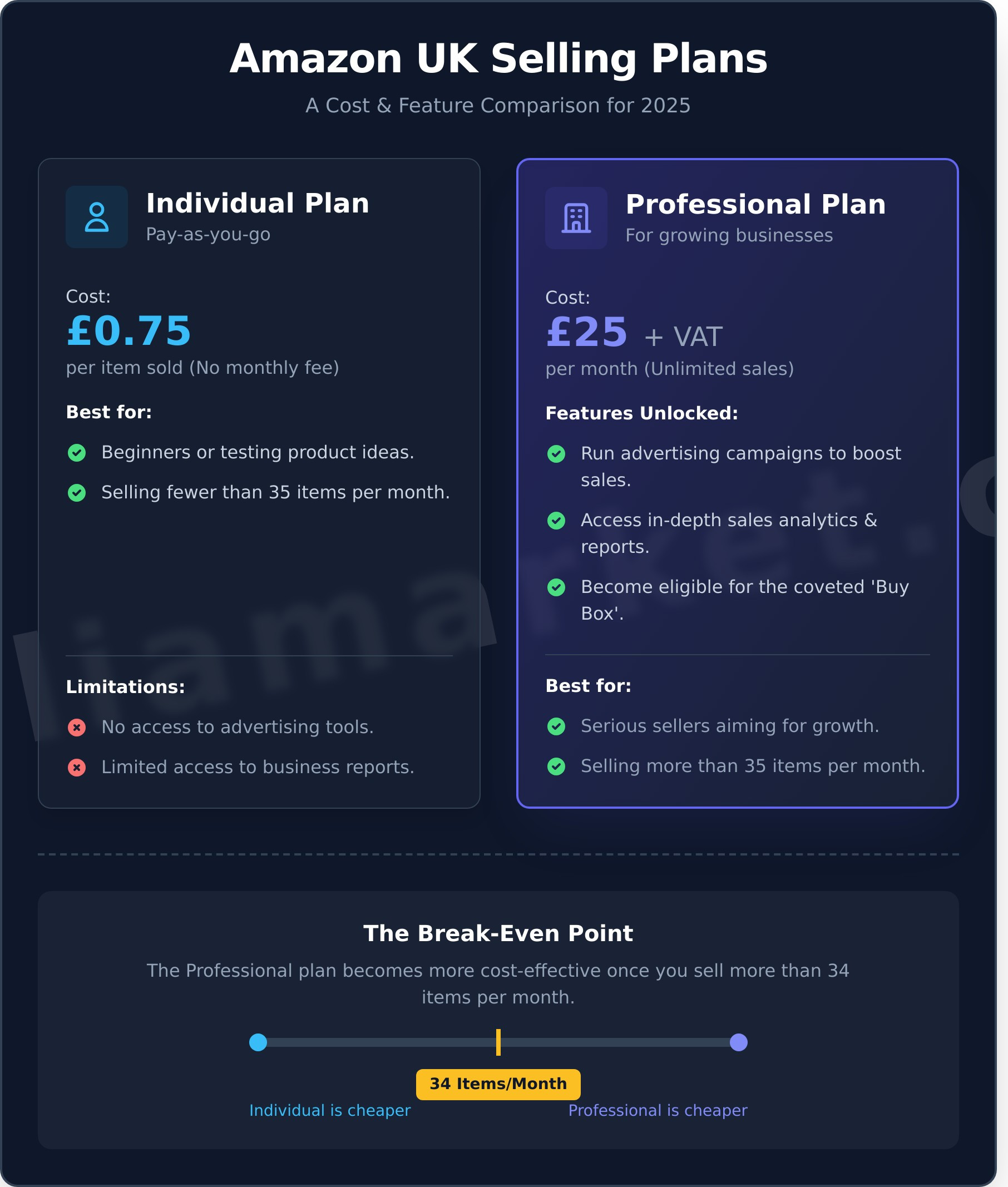
The Individual Selling Plan: For Beginners
This pay-as-you-go option is designed for those just starting out or selling in low volumes. It's perfect for testing the waters without a monthly commitment. There is no monthly subscription fee, making it a low-risk entry point.
- Cost: A flat fee of £0.75 for every item you sell.
- Best For: Sellers expecting to sell fewer than 35 items per month.
- Limitations: You won't have access to advanced features like advertising, inventory management tools, or detailed business reports.
The Professional Selling Plan: For Businesses
For serious sellers and established businesses, the Professional plan provides the tools needed to scale. This plan is essential for anyone looking to make Amazon a significant sales channel and grow their brand.
- Cost: A flat subscription of £25 + VAT per month.
- Key Benefit: Sell an unlimited number of products with no per-item selling fee.
- Features Unlocked: Gain eligibility for the coveted Buy Box, run advertising campaigns, and access in-depth sales analytics.
Which Plan is Right for You?
Making the right choice comes down to simple maths and your business goals. The key question is your sales volume and your ambition for growth on the platform.
- Calculate Your Break-Even Point: The tipping point is around 34 items per month. If you consistently sell more than that, the Professional plan becomes more cost-effective (£25 fee / £0.75 per-item fee ≈ 33.3 items).
- Consider Your Growth Strategy: If you plan to use Amazon Advertising to boost visibility or need advanced reports to manage your business, the Professional plan is a necessity from day one.
- Stay Flexible: The good news is this decision isn't permanent. You can easily switch between plans in your Seller Central account as your business needs change.
The Core Commission: Understanding Amazon Referral Fees
After your selling plan, the most significant and unavoidable cost is the Amazon referral fee. Think of this as the core commission you pay Amazon for every single item you sell on their marketplace. It's a fundamental part of calculating how much does it cost to sell on Amazon, and getting it right is essential for protecting your profit margins.
Crucially, this fee isn't just a percentage of your item's price. Amazon calculates it on the total sales price, which includes the item price plus any delivery or gift-wrapping charges paid by the customer. This is a key detail many new sellers miss.
How Referral Fees Work
The referral fee is a variable percentage that depends entirely on your product's category. Most categories have a fee ranging from 8% to 15%, but some specialist areas can be higher. Understanding these percentages is central to figuring out how much it costs to sell on Amazon for your specific products. Some categories also use a tiered system, where the percentage changes based on the item's selling price.
Referral Fee Examples by Category (UK)
To give you a practical idea, here are the 2026 projected referral fees for several popular categories on Amazon.co.uk. Always check the official Amazon Seller Central fee schedule for the most current rates before listing your products.
| Product Category | Referral Fee Rate (UK) |
|---|---|
| Books, Music, Videos & DVD | 15.3>#/td### |
| Home & Garden (including Pet Supplies) | 15.3>#/td### |
| Health & Personal Care | 8.16% on items up to £10; 15.3% on items over £10 |
| Electronics Accessories | 45.9% on the portion of the sales price up to £40; 8.16% on the portion over £40 |
Don't Forget Minimum Referral Fees
For every item sold, Amazon charges the greater of the applicable referral fee percentage or a flat-rate minimum fee. In the UK, this minimum referral fee is typically £0.25 per item. This is designed to ensure Amazon earns a baseline commission, even on very low-priced products. If you sell an item for £1.00 in a 15% category, the percentage fee would be £0.15. However, since £0.25 is greater, that's the fee you'll pay.
Shipping Costs: Fulfilment by Amazon (FBA) vs. Fulfilment by Merchant (FBM)
Beyond your seller plan, your choice of order fulfilment will dramatically impact your workload and answer the question of how much does it cost to sell on amazon. You must decide how you will store your inventory, pick and pack orders, and get products to your customers. Your two main options are using Amazon’s powerful logistics network or handling it all yourself.
What is Fulfilment by Amazon (FBA)?
With FBA, you effectively outsource your entire logistics operation to Amazon. You simply send your products in bulk to an Amazon fulfilment centre, and they take over from there. This is a popular choice for sellers who want to scale quickly and focus on sales, not shipping.
- Amazon stores your inventory: No need for your own warehouse space.
- They handle all shipping: Amazon picks, packs, and ships orders directly to customers.
- Customer service and returns are included: Amazon manages these for all FBA orders.
- Prime eligibility: Your products get the coveted Prime badge, offering fast, free delivery to millions of members.
Breaking Down FBA Fulfilment Fees
This convenience comes at a price. For each unit sold, Amazon charges an FBA fulfilment fee. This single, per-unit fee is calculated based on your product's type, dimensions, and outbound shipping weight. The costs can range from under £2 for a small, light item to significantly more for bulky goods. These complex fee structures are a core part of the online marketplace model, an area that has even been reviewed by the UK's Competition and Markets Authority when assessing market dynamics. For smaller, cheaper items, be sure to check your eligibility for the FBA Small and Light programme, which offers lower fulfilment fees.
The Alternative: Fulfilment by Merchant (FBM)
If you prefer to manage your own logistics, FBM is your path. With this model, you are responsible for the entire process after a sale is made. Calculating how much does it cost to sell on amazon with FBM means carefully tracking your own expenses for packaging and courier fees. While this gives you complete control over your stock and branding, it also means you must meet Amazon's strict performance metrics for shipping times and customer satisfaction. It’s a hands-on approach that requires significant time and efficient processes.
Beyond the Basics: Other Amazon Fees to Factor In
To truly understand how much does it cost to sell on Amazon in the UK, you have to look beyond the main charges. Your subscription, referral, and fulfilment fees form the core of your expenses, but they aren't the full picture. Several other costs can appear on your statement, directly impacting your profit margins if you haven't planned for them. Getting to grips with these 'hidden' costs is the key to accurate budgeting and avoiding unwelcome surprises down the line.
Inventory Storage Fees (FBA)
If you use Fulfilment by Amazon (FBA), you are effectively renting shelf space in their vast warehouses. Amazon charges a monthly fee based on the volume your products occupy, calculated per cubic foot. Be aware: these standard fees increase significantly during the peak Q4 shopping season from October to December. Furthermore, if your stock remains unsold for over 365 days, you'll face additional, and much higher, long-term storage fees.
Advertising Costs (Amazon PPC)
In a competitive marketplace, simply listing a product is often not enough. While optional, advertising is a necessary cost for most sellers looking to gain visibility and drive sales. Amazon's Pay-Per-Click (PPC) platform is a powerful tool, but it's an additional business expense. You bid on keywords and pay a fee every time a shopper clicks your sponsored ad. While you control the budget, it's a recurring cost to factor into your overall strategy.
Other Potential Charges
Beyond storage and ads, a few other situational fees can arise. It’s smart to be aware of them to fully calculate how much it costs to sell on Amazon for your specific business.
- Refund Administration Fee: When you issue a full refund for a product, Amazon returns the referral fee you paid. However, they retain 20% of that fee (up to a maximum of £5) as an administration charge.
- High-Volume Listing Fee: This is a niche fee that applies to sellers with a very large number of active, non-media ASINs that have not had a sale in the last 12 months.
- Removal and Disposal Order Fees: If you need to retrieve unsold inventory from an Amazon warehouse or have them dispose of it, there is a per-item fee for this service. This is crucial for managing ageing stock to avoid long-term storage fees.
Factoring these variable costs into your pricing strategy is essential for protecting your bottom line. While Amazon offers immense reach, its complex fee structure is why many UK sellers also explore platforms with more straightforward pricing. At Anglia Market, we focus on providing a clear and supportive environment for independent vendors to grow.
Putting It All Together: A Real-World Cost Example
Theory is one thing, but let's see how these fees work in practice. To truly understand how much does it cost to sell on amazon, we need to run the numbers on a real-world product. This example will break down every deduction from your selling price, showing you exactly where your money goes and what your final profit margin looks like for each sale.
The Product: A £25 Home Gadget
Let's imagine you're selling a popular gadget for the home. To make this calculation clear and simple, we'll use a standard set of figures for our hypothetical product.
- Selling Price on Amazon: £25.00 (this is the price the customer pays)
- Your Product Cost: £8.00 (the price you paid your supplier)
- Amazon Category: Home & Kitchen (which has a 15% referral fee)
- Fulfilment Method: Fulfilment by Amazon (FBA)
Calculating the Amazon Fees
Using the figures above, we can now calculate the direct fees Amazon will charge for each sale. Remember, these rates are estimates for 2026 and can vary based on your product's exact size and weight.
- Referral Fee: This is 15% of the £25.00 selling price. Total: £3.75
- FBA Fulfilment Fee: This covers picking, packing, and shipping to the customer. We'll use an estimated rate for a standard-sized item. Total: £3.50
- Monthly Storage Fee: A small but important cost for storing one unit for one month in an Amazon warehouse. Total: £0.10
Adding these together gives us the total direct cost from Amazon for selling one unit: £7.35.
Determining Your Final Profit
Now for the most important part: calculating your net profit. This simple breakdown reveals what you actually earn from each sale before other business overheads.
Start with your total revenue from the sale:
Selling Price: £25.00
Next, subtract your costs:
- Your Product Cost: £8.00
- Total Amazon Fees: £7.35
Final Profit Per Unit: £9.65
This £9.65 is your gross profit. It’s a critical number for understanding your product's viability, but don't forget to account for other business expenses like advertising, software, returns, or taxes. Feeling overwhelmed by the complex fee structures? It's a common challenge for many UK sellers. Discover a simpler selling platform.
The Bottom Line: Calculating Your Amazon UK Selling Costs
As we've seen, understanding exactly how much does it cost to sell on Amazon is a complex puzzle. From your initial selling plan to referral fees and the crucial choice between FBA and FBM, the costs can quickly add up. When you factor in storage, advertising, and other charges, forecasting your true profit margin becomes a significant challenge for any UK business.
But what if there was a simpler, more predictable way to sell online? An alternative built specifically for UK sellers.
Looking for a straightforward alternative? Sell with Anglia Market. We are a UK-based marketplace dedicated to supporting small businesses. With us, you get transparent commission fees and no hidden charges, so you always know where you stand. Join our growing community of independent UK vendors and spend less time decoding fees and more time growing your brand.
Take control of your e-commerce journey today and discover a simpler path to profit.
Frequently Asked Questions
What percentage does Amazon take from sellers in the UK?
Amazon charges a "Referral Fee" on every sale, which is a percentage of the total price a customer pays. This rate isn't fixed; it varies by product category. For most categories, you can expect to pay between 7% and 15%. For example, consumer electronics are typically around 7.14%, while clothing is often 15.3%. Always check the official Amazon UK fee schedule for your specific product to calculate your costs accurately.
Is it free to list an item on Amazon UK?
With the Individual selling plan, there is no upfront monthly subscription fee, so listing an item is technically free. However, you will be charged a fixed fee of £0.75 (plus VAT) for every item that sells, in addition to the referral fee. If you choose the Professional plan for £25 (plus VAT) per month, you don't pay this per-item fee, making it more cost-effective if you plan to sell more than 34 items a month.
Are Amazon FBA fees worth the cost for a new small business?
For many new UK businesses, Fulfilment by Amazon (FBA) is a valuable investment. While it adds fulfilment and storage fees to your costs, it gives your products the powerful Prime badge, increasing visibility and sales potential. Amazon also handles all your packing, shipping, and customer service, saving you significant time. It's best to calculate the FBA fees for your product and weigh them against the time saved and the sales boost from Prime eligibility.
How do I pay my Amazon seller fees?
Paying your Amazon seller fees is a straightforward, automated process. Amazon simply deducts all fees—including referral fees, subscription fees, and any FBA costs—directly from your sales proceeds before transferring the remaining balance to your bank account. If your sales revenue for a period doesn't cover the fees, Amazon will charge the outstanding amount to the credit card you have registered on file.
Do I need to be VAT registered to sell on Amazon in the UK?
You do not need to be VAT registered to start selling on Amazon UK if your business is based here. However, you are legally required to register for VAT with HMRC once your VAT-taxable turnover reaches the £85,000 threshold within a rolling 12-month period. It is crucial to monitor your sales closely to ensure you register on time. If you are an overseas seller storing goods in the UK, you must register for VAT immediately.
Can I sell on Amazon without a Professional account?
Absolutely. You can start with the 'Individual' selling plan, which is ideal if you plan to sell fewer than 35 items per month. This plan has no monthly subscription fee, which helps keep costs down when you're starting out. Understanding this is key to figuring out how much does it cost to sell on amazon. However, you'll pay a £0.75 per-item fee on each sale and won't have access to advanced tools like advertising or certain product categories.
No posts found
Write a review