Anglia Market vs Etsy Fees UK: The 2026 Seller’s Guide to Marketplace Costs

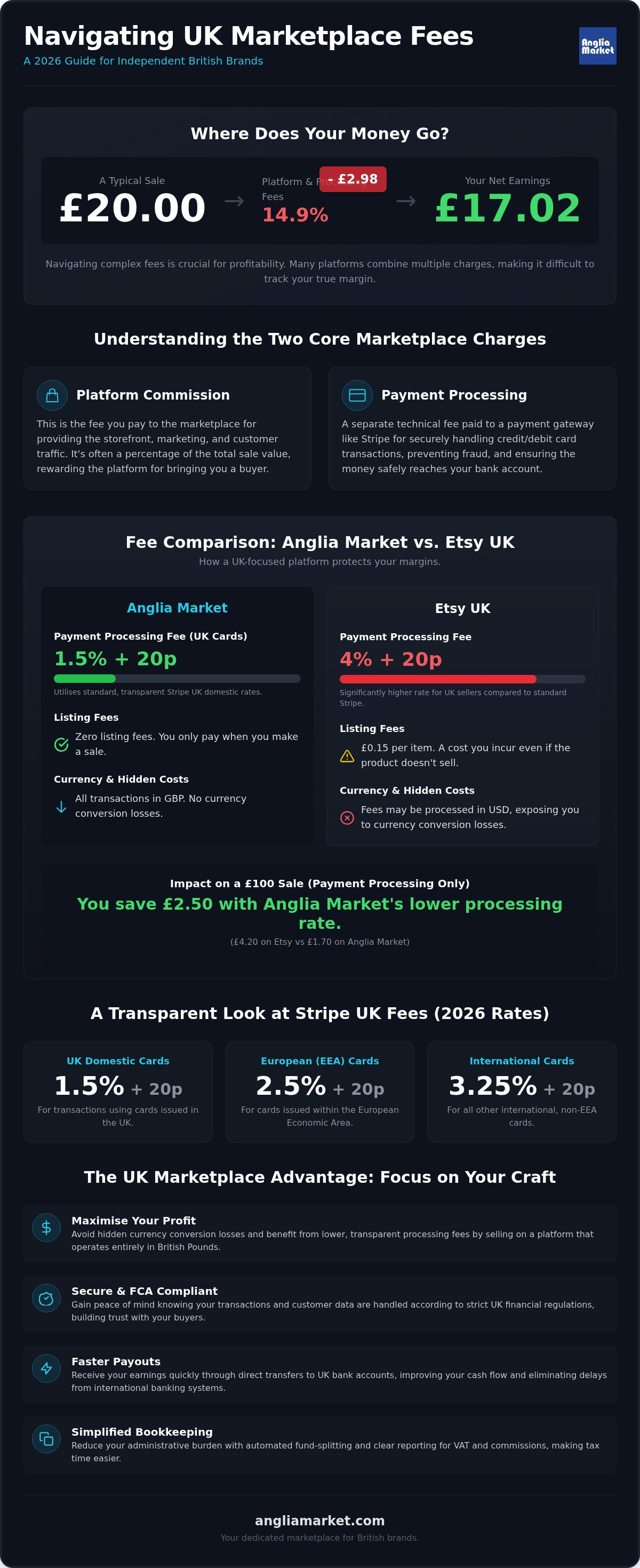
A typical £20 sale on many platforms can leave independent brands with just £17.02 after the platform takes its cut. For many, navigating marketplace fees is the difference between a thriving business and one that barely breaks even. Anglia Market understands this challenge. It is frustrating to watch your hard-earned margins disappear into a complex web of listing fees, transaction percentages, and regulatory operating charges before you even consider the cost of materials or shipping.
We know you would rather spend your time creating products than decoding opaque fee structures. This guide helps you navigate UK marketplace commissions and Stripe processing fees to maximise your profits whilst scaling your independent brand. We will provide a transparent breakdown of every penny lost to fees and help you build a pricing strategy that ensures long-term profitability. You will also discover how choosing a marketplace partner dedicated to the UK, like Anglia Market, can protect you from the currency conversion losses and VAT surprises often found on other global platforms.
Key Takeaways
- Differentiate between platform commissions and payment processing to accurately forecast your net earnings on every order.
- Analyse the total cost of Anglia Market vs Etsy fees UK to see how local platforms help you avoid the hidden currency losses common on global sites.
- Apply the 2026 Stripe UK domestic rate of 1.5% + 20p to your pricing strategy to ensure you cover all transaction costs.
- Navigate the complexities of VAT on marketplace commissions and understand how automated fund-splitting reduces your bookkeeping burden.
- Focus on scaling your craft whilst a dedicated UK marketplace handles the technical security and regional logistics of your storefront.
The Landscape of UK Marketplace Fees in 2026
The UK digital economy has shifted. Selling online used to mean accepting whatever terms global giants offered. Now, independent British brands are looking closer at the fine print. To understand what is an online marketplace in 2026, you must look beyond the storefront. It is a dual-cost system. You pay for the platform's audience and then pay again to move money safely.
Many sellers are moving to local alternatives to protect their margins. When comparing Anglia Market vs Etsy fees UK, the most overlooked cost is the currency conversion trap. Global platforms often process fees in US Dollars. This means UK sellers lose money twice; once on the fee itself and again on the exchange rate. Local marketplaces remove this layer of waste by keeping everything in British Pounds.
To better understand how these costs impact your shop, watch this helpful video:
Platform Commission vs. Payment Processing
Marketplace costs fall into two distinct buckets. The platform commission is what you pay for marketing, traffic, and the software that hosts your shop. This is often a percentage of the total sale. Payment processing is the technical fee for handling credit cards and preventing fraud. You pay this to the payment gateway rather than the marketplace itself.
Tracking these separately is vital for your bookkeeping. Most platforms use Stripe as the underlying engine for transactional safety. While the platform brings the buyer, Stripe ensures the money actually reaches your bank account. If you don't separate these costs, you won't know if your pricing strategy actually works. You might find that a high-volume product is actually losing money after the dual fees are deducted.
Why Stripe is the Standard Amongst UK Marketplaces
Stripe has become the default choice for British commerce for several reasons. It offers incredible security and reliability for UK consumers. More importantly, it ensures full FCA compliance. This means your customer's data and your payouts are handled according to strict UK financial regulations. It is about trust.
For a small business, the biggest benefit is speed. Stripe facilitates faster payouts directly to UK bank accounts. You don't have to wait weeks for international transfers to clear. It is a straightforward system built for the fast-paced modular rhythm of modern retail.
The debate between a listing fee and a final value fee is also central to the British context. Etsy charges £0.15 just to put an item live. If it doesn't sell, you still lose money. Modern UK-centric platforms often prefer a model that only charges when you make a sale. This supports independent sellers by removing the financial risk of listing new inventory. When you evaluate Anglia Market vs Etsy fees UK, remember that transparency is your best tool for growth. At Anglia Market, we focus on consolidating these technical burdens. We organise the technology so you can focus on your craft whilst we handle the logistics of the transaction.
Decoding Stripe UK Payment Processing Fees
The first section of this guide explored the broad costs of selling online. Now, let's get into the technical mechanics of the money itself. Most modern marketplaces use Stripe because it's reliable and fast. For a standard UK domestic card, the base rate is 1.5% + 20p per transaction. When you weigh up Anglia Market vs Etsy fees UK, the technical savings on payment processing alone can save you hundreds of pounds a year. Etsy's payment processing fee for UK sellers is 4% + 20p. That's a significant gap. On a £100 sale, you're paying £1.70 with standard Stripe rates versus £4.20 on Etsy just for the payment handling.
Understanding Stripe UK payment processing fees helps you see where every penny goes. It's not just about the base rate. It's about the surcharges that creep in when you sell to customers outside your home market. Tracking these small percentages is the only way to protect your net profit.
Domestic vs. International Card Rates
The cost changes depending on where the customer's card was issued. European (EEA) cards typically carry a rate of 2.5% + 20p. For international cards from outside Europe, this rises to 3.25% + 20p. Post-Brexit regulations have made these distinctions even more important for British SMEs. If your audience is primarily local, you should be paying the lower domestic rate for the vast majority of your orders.
The real "margin killer" on US-centric platforms is currency conversion. Stripe charges an additional 2% if the customer's payment currency is different from your payout currency. On Etsy, you might find your fees are calculated in Dollars and then converted back to Pounds. You lose money on the exchange rate and the conversion fee. By staying on a platform built for the UK, you keep your transactions in Sterling and avoid these hidden losses. It's a much cleaner way to manage your cash flow.
The Cost of Security: Fraud Prevention and Disputes
Security isn't just a technical feature; it's a financial safeguard. Stripe uses dynamic 3D Secure authentication to verify buyers. This reduces the risk of fraudulent "chargebacks" which are incredibly costly. A single dispute carries a £15 fee in the UK. If you lose a dispute, you lose the product, the shipping cost, and the penalty fee. It's a triple hit to your business.
Tools like Stripe Radar help filter high-risk transactions before they happen. This is especially helpful for independent vendors who don't have a dedicated fraud department. A secure, professional checkout experience doesn't just stop fraud; it builds buyer confidence. When shoppers see a familiar, secure payment journey, they're more likely to complete the purchase. If you're ready to start selling without the global platform headaches, you can set up your UK storefront today and keep more of your profit.
How Stripe Connect Powers Marketplace Transactions
Stripe Connect is the hidden plumbing of modern e-commerce. It allows multi-vendor platforms to handle payments without holding your money hostage. When you look at Anglia Market vs Etsy fees UK, you aren't just comparing percentages. You're comparing how efficiently that money moves from the buyer's pocket to your bank account. Connect is the engine that makes this possible.
The system splits funds instantly at the point of sale. When a customer buys a £50 item, the software automatically calculates the platform commission and the payment processing fee. It sends the marketplace's share to one bucket and your profit to another. This removes the need for manual invoicing. You don't have to wait for the platform to bill you at the end of the month or worry about debt building up. It's a clean, automated process that keeps your cash flow predictable.
This automation is also essential for staying compliant with UK VAT rules for online marketplaces. By splitting the transaction immediately, the digital paper trail is created for you. It's a safer way to trade because the money is never "mingled" in a single bank account. Buyers feel more secure knowing their payment is handled by a regulated provider, and vendors don't have to chase the platform for their earnings.
Direct vs. Destination Charges
Marketplaces generally use two models: Direct or Destination charges. With Direct charges, the seller is the merchant of record. This means the customer sees your business name on their bank statement. Destination charges are often preferred by UK marketplaces because the platform facilitates the transaction. This provides a layer of protection for small businesses. The marketplace handles the heavy technical lifting and fraud monitoring. It lets independent vendors focus on their craft whilst the system manages the transactional risk. For most UK SMEs, this model offers the best balance of security and simplicity.
Managing Payouts and Transfers
Payouts in the UK typically follow a T+3 schedule. This means your funds are usually available in your bank account three business days after the sale. You can track every penny through a unified marketplace dashboard. No more guessing when your money will arrive. You can see pending transfers, successful payouts, and any fees deducted in real time.
Clear financial reporting is vital for your annual accounts. Using a system like Stripe Connect ensures your bookkeeping is accurate. You can export your transaction history directly into your accounting software. This makes your tax returns simple to file and ensures you never overpay on your VAT. It's a professional, straightforward approach to managing a growing British brand.
Calculating Your Real Margin: VAT and Hidden Costs
You have calculated your listing and transaction costs. But the real margin is often thinner than it looks on paper. Understanding the difference between your gross sale and your net profit requires a look at the costs that don't always appear on a standard price tag. When comparing Anglia Market vs Etsy fees UK, the way VAT is applied to your commissions can change your entire pricing strategy.
Most UK sellers focus on the headline commission percentage. They forget that marketplaces must charge VAT on those fees. If you aren't VAT registered, this 20% charge is a sunk cost that eats directly into your profit. If you are registered, you can claim it back, but only if you have the correct documentation. Managing these small details is what separates a hobbyist from a professional British brand.
VAT Treatment on Marketplace Fees
Marketplace commissions are generally standard-rated for VAT in the United Kingdom. This means if a platform charges you a 10% commission on a £100 sale, the actual cost is £10 plus £2 in VAT. If your business turnover is below the £90,000 registration threshold, you cannot recover that £2. It simply disappears from your margin.
Always provide your VAT number to your chosen platform immediately. This ensures your monthly fee statements are accurate for your tax returns. Tracking these costs in your bookkeeping software prevents you from overpaying on your annual accounts. UK-native platforms often provide clearer, Pound-based reporting that makes this process much simpler than dealing with the US-centric dashboards found elsewhere.
The Refund Trap and Profit Protection
Refunds are a part of retail, but they carry a hidden technical cost. Stripe does not return the original processing fee when you issue a refund to a customer. If you refund a £100 order, you lose the sale and you are still out of pocket for the original 1.5% + 20p fee. In high-stakes categories like Home & Garden, where items are often heavy and expensive to ship, this can be a major blow to your weekly cash flow.
You must build a buffer into your pricing to absorb these occasional losses. One of the best ways to protect your profit is to reduce the refund rate itself. Use customer testimonials and detailed product descriptions to ensure buyers know exactly what they are receiving. High-quality social proof reduces "buyer's remorse" and keeps your hard-earned money in your bank account. If you want to keep your margins healthy and your overheads low, start selling on a platform that understands the needs of independent British SMEs.
Scaling Your UK Business with Anglia Market and Stripe
You have seen the data. You understand how hidden currency conversion and US-centric fee rules can drain your bank account. Choosing a marketplace partner is about more than just finding a low commission rate. It is about finding a platform that organises the technology so you can focus on your craft. When you evaluate Anglia Market vs Etsy fees UK, the real winner is the platform that supports your specific regional growth without technical headaches. We handle the complex payment architecture whilst you concentrate on building your inventory.
Joining a marketplace is the most cost-effective way to sell online in 2026. You avoid the massive upfront costs of building a standalone website. You also bypass the high price of individual digital marketing. By leveraging existing promotions, you can offset the cost of platform fees through increased sales volume. It is a practical, value-driven approach to e-commerce. You benefit from a shared audience that is already looking for independent British quality.
A Platform Built for UK Growth
Success in the British market requires more than just a storefront. It requires high-intent buyers who are looking for local reliability. High-intent buyers are looking for specific categories like home and garden or health and beauty. When your products are listed amongst relevant local offerings, your conversion rate improves. You aren't competing with a global sea of unrelated items. You are part of a curated UK ecosystem.
A unified checkout experience boosts your sales volume by making the purchase journey fast and secure. You get access to a broad customer base whilst keeping your overheads predictable. This modular approach to selling allows you to scale at your own pace. You don't need a team of engineers to manage your payments or security. The platform provides a supportive environment for any independent enterprise looking to expand its reach.
Getting Started: Your Storefront in Minutes
Onboarding is straightforward. You can connect your existing Stripe account and have your storefront ready in minutes. This immediate integration ensures your automated payouts are handled safely from day one. It builds a trustworthy relationship between you and your customers. You can even use the sale section to move inventory quickly during peak seasons. It is about having the right tools at your fingertips.
Don't let opaque fees eat your margins any longer. Take control of your pricing strategy. Focus on your products and let a dedicated partner handle the technical burden. It is time to scale your business with a platform built for your success. Start your journey as an Anglia Market vendor today and keep more of the profit you earn.
Protect Your Margins and Scale Your British Brand
Selling online in 2026 requires a clear view of every transaction. You've seen how the comparison of Anglia Market vs Etsy fees UK highlights more than just commission rates. It reveals the hidden impact of currency conversion and complex regulatory charges that can quietly erode your profits. By choosing a UK-centric platform, you eliminate these US-conversion losses and gain a transparent fee structure built on secure Stripe payments.
Successful scaling is about focus. You should be perfecting your products whilst a dedicated marketplace organises the technical security and regional logistics. Access to thousands of high-intent UK shoppers across diverse categories ensures your brand reaches the right audience without the burden of individual marketing costs. You deserve a partner that provides UK-based support specifically designed for independent sellers.
Ready to keep more of your hard-earned profit? Register as an Anglia Market vendor and start selling today. Your journey towards a more profitable, sustainable British business starts with a single, smart decision. We're here to help you grow.
Frequently Asked Questions
Does Stripe UK charge a monthly subscription fee for marketplace sellers?
No, Stripe UK does not charge a monthly subscription fee for standard marketplace sellers. It operates on a pay-as-you-go model where you only pay for the transactions you actually process. This is a significant advantage for independent businesses that want to keep fixed overheads low whilst they grow their inventory.
What is the difference between a domestic and an international card fee in the UK?
Domestic fees apply to cards issued within the United Kingdom, typically costing 1.5% + 20p per transaction. International fees apply to cards issued outside the UK, which cost 3.25% + 20p. When comparing Anglia Market vs Etsy fees UK, remember that global platforms often have a higher mix of international buyers, which can lead to more frequent surcharges and currency conversion costs.
Are Stripe processing fees refundable if I issue a full refund to a customer?
No, Stripe processing fees are not refundable. When you issue a full refund to a customer, Stripe keeps the original transaction fee. This means a refund costs your business the original fee amount even though the sale is cancelled. It's vital to provide accurate product details to ensure buyers are happy and to reduce the frequency of these costly returns.
How does VAT apply to the commissions charged by UK marketplaces?
UK marketplaces charge 20% VAT on their commission fees. If your business is VAT registered, you can usually reclaim this as an input tax on your quarterly return. If you aren't registered because you are below the £90,000 threshold, this VAT is a final cost that you must absorb into your pricing strategy to protect your net profit.
Can I use my existing Stripe account when I start selling on Anglia Market?
Yes, you can typically connect an existing Stripe account to your storefront. The platform uses Stripe Connect to link your accounts safely. This allows for automated fund splitting and ensures your earnings are sent directly to your verified bank account without the need for manual transfers or complex setup procedures.
How long does it take for funds from a sale to reach my UK bank account?
Funds generally reach your UK bank account within three business days after a successful transaction. This is a standard T+3 payout schedule for British vendors. Whilst your very first payout might take slightly longer due to initial security checks, subsequent transfers are fast and help you maintain a healthy daily cash flow.
What happens if a customer opens a dispute or chargeback on Stripe?
Stripe holds the disputed amount and charges a £15 dispute fee whilst the case is investigated. You must provide evidence, such as tracking numbers or proof of delivery, to challenge the claim. If you win the dispute, the funds are returned to you, but the technical fee is often retained by the processor to cover the administrative costs of the investigation.
Are there additional fees for using "Buy Now, Pay Later" options on a marketplace?
Yes, "Buy Now, Pay Later" (BNPL) options often carry higher processing fees than standard debit cards. These rates are typically between 3% and 6% depending on the specific provider used. Whilst these options can boost your conversion rate by offering buyers more flexibility, you should monitor your statements to ensure the increased volume justifies the higher cost per sale.

Here to help — ask anything
For questions about this disclaimer or the site, contact us via the website’s Contact page.
No posts found
Write a review